Live Updates
UPDATE — Oct 10, 7:03 PM CT: Oil majors cut Gulf of Mexico output as Hurricane Isaias strengthens
Oil majors are cutting production in the Gulf of Mexico as Hurricane Isaias strengthens, the Wall Street Journal reports. The move adds to the output already offline across the region as operators pull back ahead of the intensifying storm.
The WSJ did not specify a fresh barrel figure in the headline and summary available. Kingdom Exploration's read: precautionary shut-ins by major operators typically ramp up quickly as a storm strengthens, tightening near-term supply and keeping upward pressure on crude prices until facilities can safely restart.
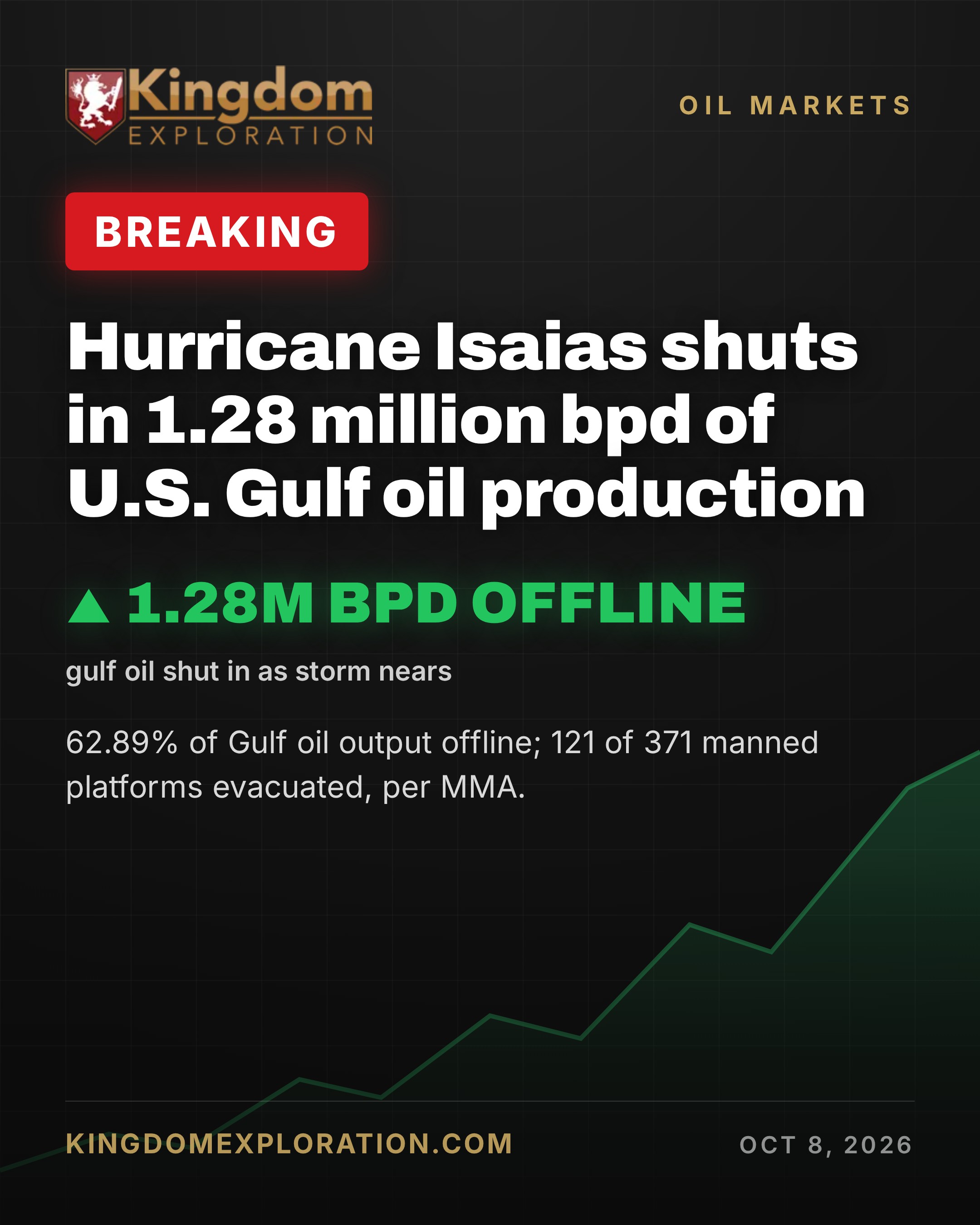
Hurricane Isaias has forced 1.28 million barrels per day of U.S. Gulf of Mexico oil production offline as operators rush to evacuate workers ahead of a storm now approaching Category 3 strength, per Oilprice.com reporting Thursday. The shut-in total has exploded nearly sevenfold in two days, from just 185,120 bpd, as the first hurricane of the Atlantic season bears down on the northern Gulf Coast.
What Just Happened
The Marine Minerals Administration (MMA) said Thursday that 62.89% of current Gulf oil production and 57.35% of natural gas production had been shut in, based on operator reports submitted by 11 a.m. CDT. Operators have pulled personnel from 121 production platforms - 32.61% of the Gulf's 371 manned platforms.
Five non-dynamically positioned rigs were evacuated, and four of the Gulf's 17 dynamically positioned rigs moved off location. Isaias strengthened into the season's first hurricane Wednesday night and was still gaining strength Thursday afternoon as it tracked toward the coast, with an expected early Saturday landfall.
The Numbers
- 1.28 million bpd of Gulf oil production shut in
- 62.89% of current Gulf oil output offline
- 57.35% of Gulf natural gas production offline
- 121 platforms evacuated (32.61% of 371 manned platforms)
- Shut-in surged from just 185,120 bpd two days earlier
- Tuesday: only 9.24% of oil output offline, with one company reporting; Thursday's survey included 12 companies
Oil markets were already in motion before the latest shut-in figures landed. WTI jumped roughly $4 per barrel Thursday morning and Brent gained nearly $5 - a move the source ties to explosions reported in Riyadh, which added a separate supply-risk layer to an already tight market.
Why Oil Prices Could Rise
The Gulf of Mexico is a core pillar of U.S. crude supply, and losing more than 1.2 million bpd in a single stretch is a material near-term hit to output. Barrels stay offline until offshore facilities can be inspected and safely restarted - and the pace of the shutdown has accelerated fast as more operators clear the storm's path.
MMA said undamaged facilities will return to service once standard checks are completed. The risk to prices runs deeper if the storm inflicts structural damage: any harm to platforms or infrastructure would keep some of that production offline well beyond the storm's passage, extending the supply gap. Stacked against an already tight market absorbing separate geopolitical risk, a disruption of this scale can feed directly into a firmer risk premium on crude.
What to Watch Next
The MMA plans another evacuation and shut-in update Friday afternoon - the key data point for gauging whether output losses deepen further. The storm's current track puts parts of the Florida Panhandle and Alabama at risk for storm surge of up to 7 feet and heavy rainfall, with some locations potentially receiving 10 inches or more. Forecasts had Isaias approaching Category 3 strength before weakening ahead of the expected early Saturday landfall.
Watch for: the Friday MMA figures, confirmation of landfall strength and location, and - critically - early damage assessments once crews can return offshore. The faster facilities pass inspection, the faster barrels come back.
Reporting sourced from Oilprice.com. Developing story.
About Kingdom Exploration
Kingdom Exploration LLC is an Oklahoma-based oil and gas exploration company. Learn more at kingdomexploration.com.

